§ ALTERNATIVES · ALT TO VWO
VWO alternative for Shopify: A/B testing at $99/mo, no CRO team
VWO is built for enterprise testing teams. ShopShift is $99/month, one script tag, and the AI runs and ships the winning tests on your Shopify store for you.
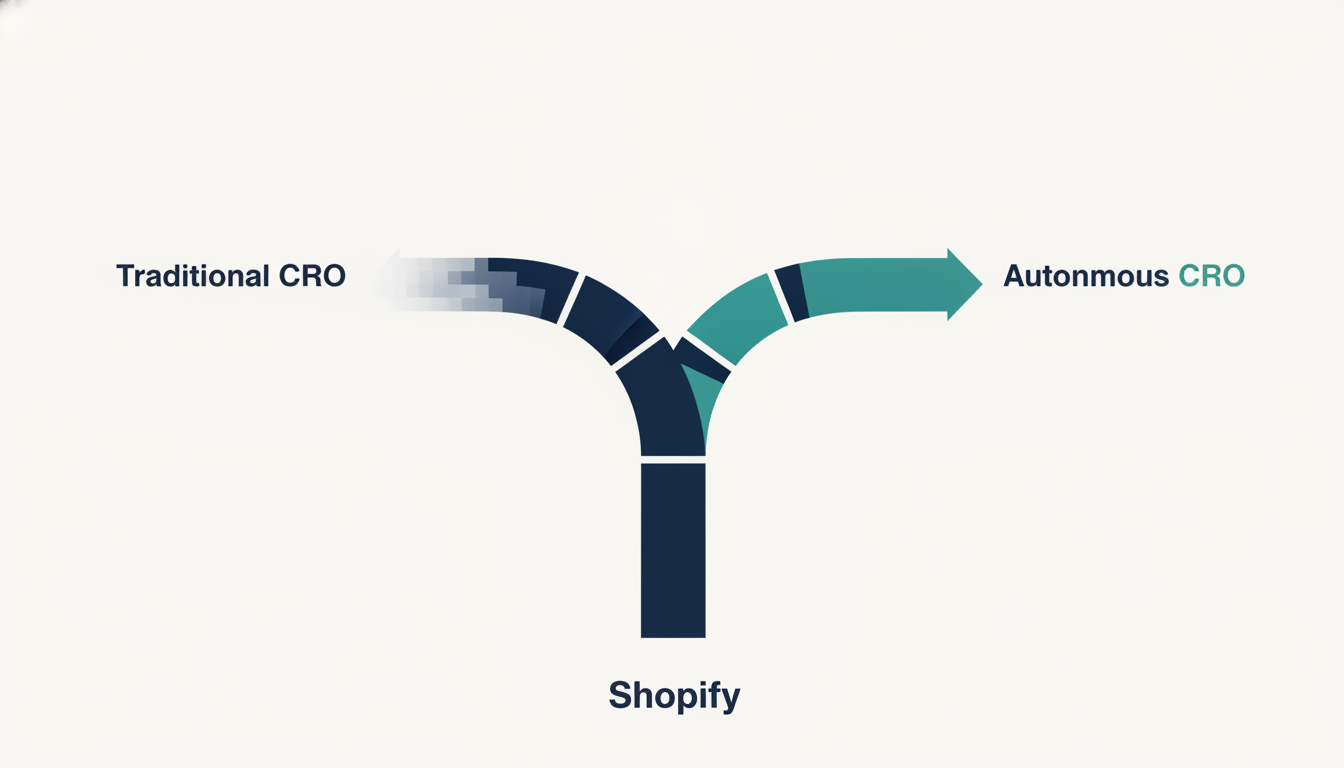
ShopShift runs autonomous CRO on your store — start free.
Does VWO work with Shopify? Yes — it installs via a JavaScript snippet or VWO's Shopify app, though checkout testing is heavily restricted. Paid plans start around $220/mo as of September 2026. ShopShift is the autonomous alternative: paste one script tag, AI runs every experiment, $99/mo flat. Honest comparison below.
TL;DR
- VWO works on Shopify. It installs through a theme snippet or its Shopify app, but Shopify's checkout extensibility rules mean VWO cannot test checkout pages on standard plans — and only in a limited way on Shopify Plus.
- VWO is a full experimentation platform built for teams with a dedicated CRO function: analysts writing hypotheses, sizing samples, and reviewing statistical output.
- ShopShift is autonomous conversion optimization: an AI layer that designs, runs, and rolls out experiments on your Shopify store with zero human test design.
- ShopShift is not a replacement if you need server-side testing, multi-site programs, enterprise governance, or dedicated support — VWO wins there, plainly.
- ShopShift IS the answer if you run a Shopify store and want conversion lifts without hiring a CRO specialist or retaining a consultant.
- Cost gap as of September 2026: VWO's smallest paid testing plan runs roughly $220/mo billed annually; ShopShift is $99/mo flat with no tested-user caps.
Why people look for VWO alternatives
VWO has been a mainstay of A/B testing since the early 2010s, and the platform keeps expanding — heatmaps, session recordings, funnel analysis, form analytics, a visual editor, and a growing set of AI-assisted features like automated copy variant suggestions. For a mid-market retailer with a conversion team, that breadth earns its keep.
The trouble starts when smaller Shopify merchants adopt it. VWO assumes someone on your team already knows how to frame a hypothesis, size a sample, and read a significance report. The onboarding, the plan tiers, and the dashboards all bake in that assumption. Without a dedicated CRO person, many merchants end up paying for a subscription while their experiment queue sits empty.
Pricing is the second pressure point. VWO meters by monthly tested users (MTUs), and an active Shopify store can burn through an entry-tier allowance in a couple of weeks. Once you cross into Growth or Pro tiers, monthly spend climbs past what most independent merchants allocate for their entire tooling stack. That arithmetic is what sends people searching for alternatives.
VWO Shopify integration: setup, checkout limits, and cost
Since the queries bringing people here ask directly: yes, VWO integrates with Shopify. Here's how it actually works in September 2026.
Installation. You add VWO's asynchronous SmartCode snippet to your theme's theme.liquid file, or install it through VWO's listing in the Shopify App Store, which injects the snippet for you. Either route takes a few minutes. From there, experiments are built manually in VWO's visual editor and pushed to your storefront.
Checkout limits. This is the part VWO's marketing pages soft-pedal. Since Shopify retired checkout.liquid in 2024 and moved everyone to checkout extensibility, third-party scripts no longer run on checkout pages for standard Shopify plans. VWO can test your product pages, collections, cart, and landing pages — but not the checkout itself. On Shopify Plus, some checkout customization is possible through Shopify's sanctioned extension points, but it's a fraction of what VWO offers on an open web stack. If checkout testing is your priority, no client-side tool (ShopShift included, for checkout page internals) fully escapes this constraint; ShopShift instead optimizes the paths into checkout — cart, shipping messaging, trust signals, and buy-button placement.
What VWO costs on Shopify (September 2026):
| Plan | Approx. monthly price (annual billing) | Tested users included |
|---|---|---|
| VWO Starter (Testing) | ~$220/mo | 10,000 MTU |
| VWO Growth | ~$412/mo | 50,000 MTU |
| VWO Pro | ~$931/mo | 100,000 MTU |
| VWO Enterprise | Quote-based, typically four figures | Custom |
| ShopShift | $99/mo flat | Unlimited |
VWO adjusts published pricing periodically, so treat these as the figures visible on vwo.com as of this refresh. The structural point holds regardless: VWO's cost scales with traffic; ShopShift's doesn't.
For a deeper head-to-head, see our full ShopShift vs VWO comparison.
What ShopShift is — and how it's different from VWO
ShopShift belongs to a different category. It isn't a manual testing platform with a friendlier interface — it's autonomous conversion optimization. The AI decides what to test, generates the variants, allocates traffic, monitors significance, and deploys winners permanently. You never design an experiment.
Installation is a single script tag pasted into your Shopify theme (or one click via the native app). The system then audits your layout, copy, pricing presentation, CTA placement, and pre-checkout flow, and generates hypotheses from patterns in your own visitor behavior rather than a generic best-practices playbook. First experiments typically launch within a day or two. Winners get applied automatically; losers get logged with a plain-English explanation and the queue moves on.
The real difference is time-to-value. ShopShift exists for the store owner who is simultaneously the marketer, the support desk, and the fulfillment coordinator. Conversion optimization shouldn't demand a sixth job title.
Is ShopShift a true alternative to VWO?
Honest answer: it depends on your situation.
Yes, ShopShift is the right alternative if:
- You run a Shopify store and want continuous conversion improvement without designing or reviewing tests yourself.
- You've paid for VWO (or evaluated it) and realised nobody on your team has hours to actually run experiments.
- You want a flat, predictable subscription instead of MTU-based pricing that grows with your traffic.
No, don't switch to ShopShift if:
- You employ a CRO team that needs granular control over traffic splits, audience targeting, and custom conversion metrics.
- You require server-side experimentation across a custom or headless stack.
- You lean on VWO's heatmaps, session recordings, and surveys as a core research workflow.
- You need enterprise procurement boxes ticked: SSO, audit logs, SLAs, and a named customer success manager. VWO delivers all of that; ShopShift doesn't pretend to.
We'd genuinely rather send you to VWO for the right reasons than oversell ShopShift for the wrong ones.
Feature comparison
| Feature | VWO | ShopShift |
|---|---|---|
| Who designs experiments | Your CRO team | AI — fully autonomous |
| Platforms supported | Web (any stack), mobile SDKs | Shopify only |
| Setup | JS snippet or Shopify app + visual editor onboarding | Single script tag, done |
| Experiment types | A/B, multivariate, split URL, server-side | A/B and multivariate on Shopify storefront |
| Checkout testing on Shopify | Blocked on standard plans; limited on Plus | Optimizes pre-checkout paths |
| Heatmaps & session recordings | Yes (plan-dependent) | No |
| Statistical method | Bayesian (SmartStats) | Bayesian, continuous monitoring |
| Winner rollout | Manual — you apply it | Automatic |
| Pricing model | Usage-based (tested users/mo) | Flat $99/mo |
| Dedicated support | Yes, on higher tiers | Email + docs |
| Reporting | Deep dashboards, segmentation | Plain-English summaries |
Pricing comparison
As of September 2026, VWO's Starter testing plan runs roughly $220/mo (billed annually) for 10,000 tested users per month. Growth — needed for higher traffic plus behavioral targeting — sits around $412/mo, and Pro near $931/mo. Enterprise is quote-based and typically lands in four figures monthly.
ShopShift is $99/mo flat. No MTU caps, no seat fees, no add-on modules. One plan, everything included.
For a Shopify store doing 50,000 monthly sessions, the annualised gap between VWO Growth and ShopShift is roughly $3,750 — before counting the analyst or consultant hours VWO needs to be worth its subscription.
Full ShopShift pricing at /pricing.
When to stay with VWO
- You have an active CRO team. A conversion specialist who lives in experimentation dashboards will get real value from VWO's depth — multivariate testing, advanced segmentation, server-side experiments, feature flags. To that team, ShopShift's autonomy would feel like giving up the steering wheel.
- You need enterprise features and dedicated support. SSO, permissions, audit trails, SLAs, and a customer success manager who answers the phone. VWO wins here without contest.
- You need cross-platform or server-side testing. VWO runs on any web stack and ships mobile SDKs. If your program spans a React frontend, an app, and a headless commerce layer, VWO is the correct tool.
- Qualitative research matters daily. VWO bundles session recordings, heatmaps, and surveys that ShopShift simply doesn't offer.
When to switch to ShopShift
- You're a Shopify merchant without a CRO function. You want conversion lifts, not another interface to master. ShopShift owns the whole loop — hypothesis, test, result, rollout.
- Your testing tool has been idle. If you've run fewer than five experiments in the past year, the bottleneck is human bandwidth, and ShopShift removes the human dependency entirely.
- You want budget predictability. $99/mo flat, with no penalty as traffic grows, is easier to plan around than tiered MTU pricing.
Frequently asked questions
Q: Does ShopShift replace VWO's visual editor?
Not directly. VWO's editor lets a human point-and-click any page element and assign variants to audience segments. ShopShift has no manual editor because the AI identifies what to change and builds variants itself. If you want hands-on control over exactly what gets tested, VWO's editor is the right tool. If you want experiments to happen without that human step, ShopShift covers it.
Q: Can I run ShopShift and VWO together?
Technically possible, practically a mess. Two systems mutating the same storefront will contaminate each other's statistical models and produce results neither can trust. Pick one: autonomous optimization (ShopShift) or manual experimentation tooling (VWO).
Q: How quickly does ShopShift start running experiments after install?
Most stores see a first live experiment within 24–48 hours of pasting the script tag. The AI collects a short baseline of your current performance before proposing its first test, then experiments queue and run continuously.
Q: What statistical method does ShopShift use?
Bayesian inference with continuous monitoring — the system calls a winner or loser as soon as the evidence is strong enough, without a pre-defined sample size or fixed analysis window. VWO's SmartStats engine is also Bayesian, so on statistics the two are closer than they once were; the difference is who acts on the result. In VWO, a human reads the report and applies the winner. In ShopShift, rollout is automatic.
Q: Is ShopShift only for Shopify?
Yes, deliberately. Shopify-only focus gives ShopShift deep hooks into theme architecture, product data, and the pre-checkout flow — the specificity that makes autonomy possible. VWO's platform-agnostic design is more flexible but necessarily more generic about how it understands your store.
Q: What happens when an experiment doesn't produce a winner?
ShopShift records it as a non-improvement, logs a plain-English explanation in your dashboard, and moves to the next hypothesis automatically. No action needed from you. Over time the system accumulates a store-specific record of what works and what doesn't.
Related reading
START TRIAL
Try ShopShift on your store.
The AI runs the same loop this post just described — discovery, hypothesis, variant design, winner selection — from a single script tag. No experiments to design.
30-day free trial · cancel any time
§ RELATED · COMPARISON